

Analyzing and tracking citations plays a crucial role for researchers at all levels – PhDs, postdocs, principal investigators (PIs), and industry scientists – enabling them to understand the impact of their research. Citation analysis studies how, when, and where others cite research papers in journals. By analyzing their citations, researchers gain deep, trustworthy insights into how their research influences their field and shapes future directions.
The process encompasses qualitative analyses, such as examining the mentioning, supporting, and contrasting examples within existing literature, and quantitative analyses, through citation metrics such as citations counts, Impact Factor, or the SCImago Journal Rank. This combined approach allows scientists to track evolving trends and refine their academic or industry strategy.
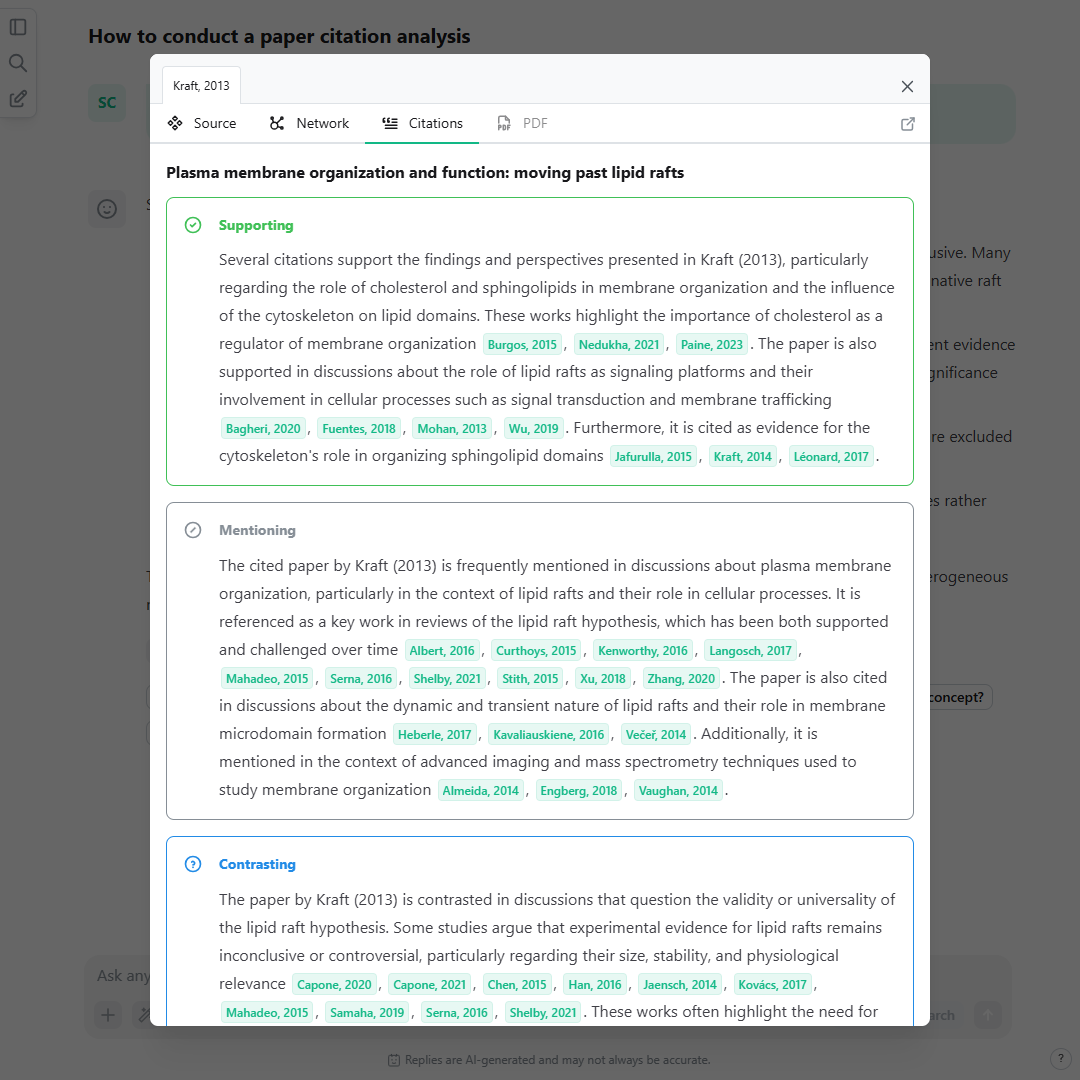
Consensus analysis. A screenshot showing a consensus analysis by scienceOS grouping citation quotes into supporting, mentioning, and contrasting statements.
For example, consensus analysis – a special type of citation analysis – is essential to a literature review for a new project. That is, understanding whether the identified publications are supported, contrasted, or mentioned in existing research to refine your hypotheses, identify gaps in the literature, and position your study for optimal relevance and influence.
Building hypotheses on foundational scientific articles that support or challenge your premise strengthens your project and aligns it with key publications that shaped current knowledge. Additionally, citation tracking can reveal potential collaborators frequently referencing your research or working in complementary areas, promoting your impact.
AI research agents like scienceOS help support citation analysis and tracking, allowing researchers to efficiently evaluate the significance of their papers while refining strategies for broader influence.
Run a consensus analysis with an AI agent
The AI research agent scienceOS employs large language models to identify, analyze, and assess the full-text citation quotes of a research paper for consensus analyses.
- Login
Login to your scienceOS account and start a new chat.
- Ask a question
Ask a research question. The AI science chat generates an answer, including links to the sources of the information.
- Select a paper
Click on a source to analyze it. You will find all relevant details in the tab ‘source’ and may create a citation network in the ‘citation network’ section.
- Open the ‘consensus’ tab
Select the ‘consensus’ tab for an overview of the citation quotes. Here, you may discover other studies related to the source and analyze whether they support, mention or contrast the initial source.
- Investigate citations
Click on the referenced sources to open them in a separate source tab for additional insights.
Conducting a consensus analysis of a single source. A brief video highlighting how to create a citation network and conduct a consensus analysis of a single source with scienceOS.
Not all scientific articles feature all three categories; some are only mentioned, others provide just supporting examples, and some offer contrasting results.
To perform consensus analyses directly from specific research papers, you can utilize the AI PDF chat feature. Upload the full-text PDF, and scienceOS will automatically recognize the publication and provide a structured summary of the paper. Once identified, select the source and navigate to the consensus tab to generate a consensus analysis. This streamlined process provides insights into a document’s research impact without requiring manual organization.
PDF-based consensus analyses. A brief video showing how to generate citation networks, consensus analyses and extract answers from an uploaded document.
Further, after transferring your scientific library from a reference manager to scienceOS, you may also conduct a consensus analysis using the sources in your library. This allows you to check if your reference manager already contains these papers or if you have discovered new sources to complete your collection of literature.
With qualitative analysis and additional features like the citation network, the AI research agent scienceOS offers a clear overview of a research question. Researchers can then analyse a source’s connections to uncover insights, identify key studies, and understand its broader context.
Generate a consensus analysis
The AI-powered research tool scienceOS is designed for researchers at all stages, offering an efficient way to perform consensus analyses. Whether you are beginning with a research question or building upon existing literature, scienceOS supports the process of evaluating and understanding the impact of your research.